Remote I/O: Why Distributed Control Starts at the Edge
Automation systems are increasingly distributed. Sensors, actuators and equipment may be located throughout a train, energy infrastructure, industrial installation or other critical application. All of these elements still need to interact with the control architecture.
This creates an important question: should every field signal return to one central location, or should part of the I/O architecture move closer to the equipment?
Bringing I/O closer to field equipment
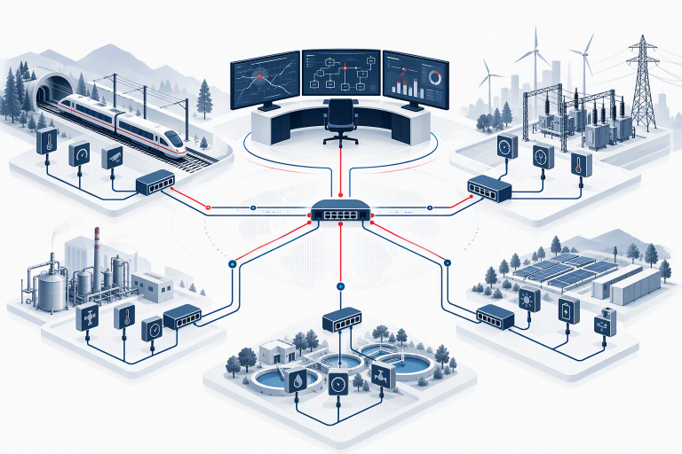
Remote I/O allows input and output functions to move closer to field equipment. The conceptual architecture becomes:
FIELD EQUIPMENT → REMOTE I/O → COMMUNICATION → CONTROL.
Remote I/O is therefore more than a collection of input and output channels. It becomes part of the overall system architecture.
Start with architecture, not hardware
- Where is the equipment physically located?
- Where are signals produced?
- Which systems require access to them?
- How should control functions be distributed?
- How should the different parts communicate?
- How might requirements evolve?
These questions help define what the I/O architecture actually needs to achieve before hardware is selected.
BRIO within distributed automation architectures
Within the LEROY Automation portfolio, BRIO addresses Remote I/O requirements. BRIO can be considered as a building block within a wider architecture involving field equipment, I/O, communication and control.
Design around the application
There is no universal architecture for every project. Railway, Energy, Defence and industrial applications present different field constraints and integration requirements. The objective is not simply to distribute hardware. It is to build the architecture around the reality of the application.
Designing a distributed control architecture?
Talk to LEROY Automation about Remote I/O and integration requirements.