
The Future Isn’t Another Box. It’s an Architecture.
Railway systems are becoming more capable, more connected and more complex.
More onboard control. More communication. More I/O. More diagnostics. More cybersecurity. More data to process and exchange.
Individually, each new function can solve a real operational need. But at system level, every additional function can also introduce another layer of complexity: new hardware, additional interfaces, integration work, qualification constraints, maintenance references and potential obsolescence over the programme lifecycle.
The question, therefore, should not simply be:
“Which new box should we add?”
It should be:
“What architecture does the mission actually require?”
Start with the mission, not the hardware
A railway electronic architecture should begin with a clear understanding of what the system needs to achieve.
- Which functions must be controlled?
- Which signals need to be acquired?
- Which systems need to communicate?
- Which data flows need to cross network boundaries?
- Which information needs to be protected?
- How might these requirements evolve throughout the life of the programme?
Answering these questions first changes the conversation.
Instead of selecting individual devices independently, engineering teams can consider the system as a whole and understand how control, I/O, communication and cybersecurity should interact within one coherent architecture.
For onboard applications, this broader approach is particularly relevant when defining a TCMS architecture, where vehicle control units, I/O modules and communication gateways need to work as part of an integrated system.
Integration has a cost
Adding another device may look like the simplest way to introduce a new capability.
But the hardware itself is only part of the equation.
Every additional equipment reference can potentially mean additional interfaces to manage, cables to route, software to integrate, documentation to maintain, configurations to control and components to support throughout the lifecycle.
As architectures grow, these interactions matter.
A more integrated approach can help engineering teams identify where functions should remain independent and where they can be consolidated or structured more efficiently.
The goal is not necessarily to reduce the number of devices at any cost.
The goal is to make sure that every element of the architecture has a clear purpose.
One example is the use of Remote I/O within a distributed control architecture, where I/O functions can be positioned closer to field equipment rather than systematically routing every signal back to a central location.
Within the LEROY Automation portfolio, BRIO Remote I/O modules provide a building block for railway control-command architectures.
Design railway architectures for change
Railway programmes are rarely static.
Requirements can evolve. New functions can appear. Communication needs can change. Cybersecurity constraints may become more demanding. Components can reach obsolescence while the vehicle itself is expected to remain in service.
This makes architectural flexibility particularly important.
A system designed only around today’s list of functions can create constraints tomorrow.
An architecture designed around clear interfaces, modular functions and well-defined responsibilities is better positioned to accommodate future evolution.
Communication is part of this lifecycle challenge. Railway communication gateways can support data exchange between different railway systems and assist with the integration and modernization of existing installations.
What will this architecture need to support five, ten or even twenty years from now?
Cybersecurity should be part of the architecture
Increasing connectivity also means that communication boundaries need to be considered from the architecture stage.
- Which systems need to exchange information?
- In which direction should information travel?
- Should every communication path really be bidirectional?
For applications that require information to leave a protected environment without opening the same communication path in the opposite direction, DataDiode DTD implements hardware-enforced unidirectional data flow for railway communications.
Cybersecurity therefore becomes more than an additional device or feature. It becomes another architectural consideration when defining how systems communicate and how critical data flows should be managed.
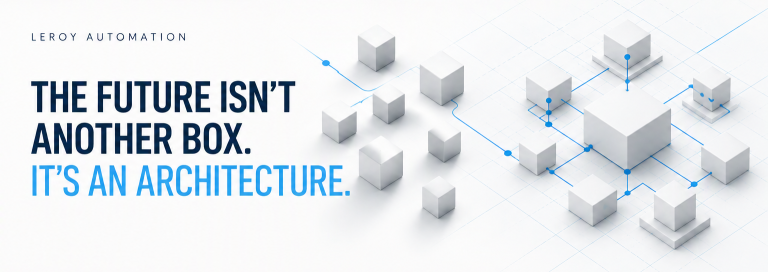
Control. Connect. Protect. Evolve.
For LEROY Automation, this is where technologies such as TCMS and embedded control, Remote I/O, communication gateways and railway cybersecurity become part of a broader architectural conversation.
Not as separate boxes looking for a place in the vehicle, but as building blocks selected according to the requirements of the application.
The objective is to create an architecture that can:
- CONTROL the functions required by the mission.
- CONNECT systems and distributed equipment effectively.
- PROTECT critical communication boundaries and data flows.
- EVOLVE as programme requirements change.
Because the future of railway electronics is not about continuously adding more equipment.
The future isn’t another box. It’s an architecture.
Building your next railway electronic architecture?
Defining a new TCMS, Remote I/O, gateway or railway cybersecurity architecture?
Let’s start with the requirements and review the architecture together.
Explore LEROY Automation railway solutions
LEROY Automation | RECORD. PROTECT. EVOLVE.